
This is not an official website of Corbett national park. It is registered under the private travel agency name Seven Safar Tour & Travels. We organize Hotel, Safari and Tour Package bookings in Corbett national park.
Corbett National Park is one of the most visited tourist destinations, as the place is rich in flora and fauna. Corbett Tiger Reserve is the second largest Tiger reserve in India after Sunderbans. The park was Established in 1936 as Hailey National Park. The entire area is spread over 500 sq. km. The area contains river belts, hills, marshy depressions, large lakes, and grasslands. Jim Corbett National Park is a rare national tiger reserve where it is allowed to stay during the nights.
You can enjoy an evening of wildlife and roam around in the lap of nature on an elephant's back or an open jeep. Apart from tigers, You will find leopards, wild elephants, and crocodiles. So, this is the most sought-after place for the wildlife buffs, as many film shootings have occurred here. Jim Corbett National Park is situated in Nainital District, Uttrakhand. In winter, the temperature goes as low as 4-5 degrees. In summer, the temperature is a shade over 30 degrees at max. Most mornings at Jim Corbet are foggy.

The Royal Bengal Tiger is one of the famous animals called Jim Corbett, and it is their home. On April 1st, 1973, India’s tiger conservation program was launched in Jim Corbett’s forest. The Royal Bengal tigers are difficult to notice since the reserve is covered with various vegetation that provides camouflage and cover. This dense jungle and Ramganga River also offer the ideal hunting grounds for tigers looking for their prey.
Corbett Tiger Reserve has about 1100 Asian elephants. They are part of the migratory population living in Rajaji National Park. Earlier, there were fewer elephants, but their population and number in Jim Corbett Park have increased significantly in recent decades. Although elephants are present throughout Jim Corbett National Park, elephants are most easily sighted in Dhikala Chaur, Phulai Chaur, Bijrani, and Jhirna zones of Jim Corbett National Park. Moreover, elephants are social and live in groups of females. Their young, eldest, and most experienced females lead them. Adult males usually travel alone and associate with female herds for mating.

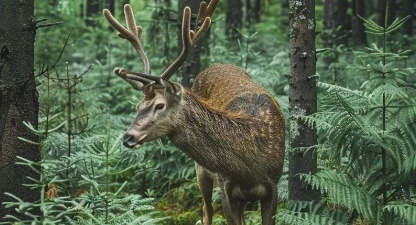
The biggest deer in Jim Corbett National Park is the sambar. Most of its body is a consistent grayish-brown, except for creamy white patches on the back and under the tail. Males have thick manes on their necks and antlers that can grow to be 1 m long. Sambar are primarily found in deep forests and spend most of their time alone. However, they gather in small groups during the mating season.
Its body is uniform, greyish-brown, except for creamy white on the backsides and under-tail areas. Males have up to 1 m long antlers that are periodically shed and replaced. Male sambar also have dense hairs on their necks.
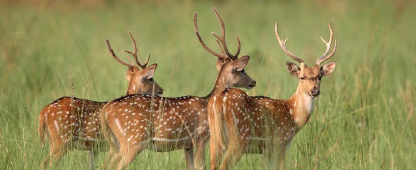
The Chital, or spotted deer, is Jim Corbett National Park's most prevalent deer species. They are quite attractive, with distinctive white dots on their reddish-brown body. Only male chital have antlers that can reach up to 1m. The primary food source for them is grass. However, they rely on the forested regions' flowers, fruits, and leaves.
They prefer to graze in short grasslands with little shelter to keep an eye out for predators.
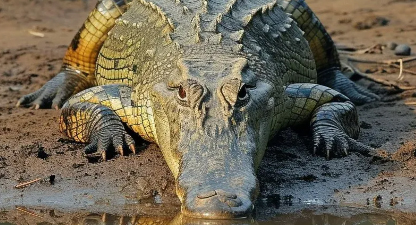
One of the world's biggest and most endangered crocodiles is the gharial, which can only be found on the Indian subcontinent. The gharial's thin snout is designed to consume fish. Young gharials may consume invertebrates and insects. In Ramganga, a Jim Corbett National Park river, more than 400 gharials may swim in deep pools or soak in the sun on its banks.
Adult male gharials have a rounded growth on the tip of their snouts, called a Ghara. It enhances vocal communication by acting as a resonator that produces a loud buzzing call. The Ghara is also a visual stimulus for females during the breeding season and helps produce bubbles during courtship displays. Males begin to develop their gharas around ten years of age.